
Exposed to the Fire of the Enemy: Surgeons Killed at Antietam
Army surgeons working on the battlefield during the Civil War faced as great a risk of death as the soldiers they were caring for. As Dr. Jonathan Letterman, Medical Director for the Union Army of the Potomac stated:
It is not an uncommon belief that medical officers are seldom exposed to the fire of the enemy. My observation and experience since I have been connected with this army, especially, has shown me that they are about as much exposed as officers of the line. Some have fallen in the discharge of their duties; and I am fully justified in saying that in no department has greater devotion or more courage been shown than by medical officers in the[se] battles.
Letterman had begun his re-organization of the medical department in August of 1862, when he officially formed the Ambulance Corps. He also began implementing his plan for treatment of wounded soldiers, which would eventually evolve into the Letterman Plan. Under this plan, surgeons were to establish field dressing stations on the battlefield, where soldiers would receive immediate treatment for their injuries before being evacuated. Medical personnel were also responsible for choosing buildings a few miles away from the fighting to use as field hospitals, where the wounded would be sent for more advanced care.
Letterman’s system had its trial-by-fire at the Battle of Antietam on September 17, 1862, the bloodiest single day in American history, with 23,000 casualties. Despite the success of the Ambulance Corps in removing all the wounded from the battlefield in 48 hours, and the successful evacuation of wounded soldiers to the city of Frederick, the system still had many glitches that needed to be worked out. One of these was to ensure the safety of the surgeons who were on the battlefield tending to the wounded.
Three Union surgeons and one Confederate surgeon were killed at the Battle of Antietam.

William James Harrison White (Photographic History of the Civil War, 1911)
Surgeon William James Harrison White was born in 1827 in Washington, D.C. and graduated from the Columbian College Medical School (now George Washington University) in 1849. He was appointed as a surgeon in the regular army and served in Texas and New Mexico. At the start of the Civil War in 1861, he was put in charge of the General Hospital in the Washington, D.C. infirmary and became a member of the Army Medical examining board. He was assigned as the Medical Director of the 6th Army Corps in April of 1862 and was in this position at the time of the Battle of Antietam. On the morning of September 17, White established the corps hospital on the Michael Miller farm and began attending to the wounded. However, during the afternoon, White apparently suffered some kind of mental breakdown. According to a memorial written by Army Surgeon General Hammond published in the New York Times in October 1862:
During the whole of the terrible battle of Wednesday Dr. WHITE was superintending the care and removal of the wounded from the battle; and it is supposed the excitement consequent to the occasion produced a species of temporary insanity, for after the battle had lulled somewhat, he rode up to Gen. FRANKLIN and said, “General, if you will give me a regiment of men I will clear those woods of rebels,” pointing to a piece of woods on his right in which was stationed a very large force of rebels.
Gen. FRANKLIN replied, that fifty regiments would be unable to dislodge the enemy from the position, and that it would be useless to attempt the experiment. Dr. WHITE rejoined, “If you will not give me the men to take those woods, I will go and take them myself,” at the same time proceeding in the direction of the place where the rebels were concealed, at a rapid gait. When within about twenty or thirty rods of the edge of the wood, he was fired upon by several rebel sharpshooters, two balls taking effect, one in the forehead and another in the breast, killing him instantly.
According to the same account, the Confederate who killed White was taken prisoner and “professed to be very sorry upon learning that his victim was a surgeon instead of a Major, which he took him to be by his shoulder-straps.”
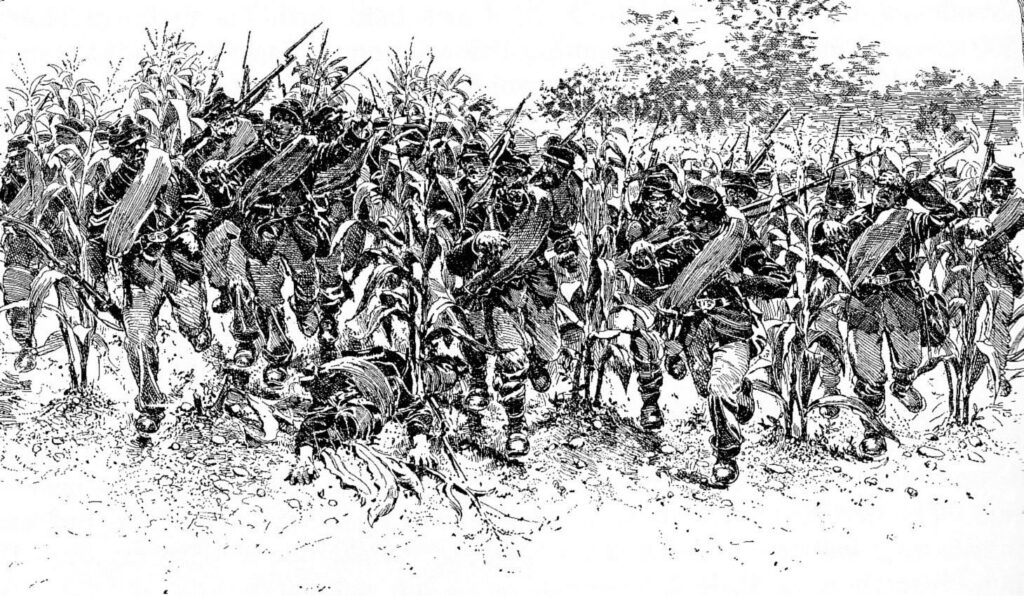
Into the Cornfield (www.sec.state.ma.us)
Assistant Surgeon Albert Asaph Kendall was born in 1828 in Middlebury, Vermont and graduated from New York University Medical School in 1852. He was commissioned as the Assistant Surgeon for the 12th Massachusetts Infantry in April 1862. Kendall was killed while with his regiment near the East Woods before their advance into the Cornfield. The regiment suffered the highest percentage loss (67 percent) of any Union regiment that day. Perhaps, like White, he was mistaken for an infantry officer, as the medical insignia on uniforms was difficult to see at a distance. The Winchester Accord had been signed by both Union and Confederates and put into place in June 1862, designating medical personnel as non-combatants, so it is likely that Kendall’s death was not intentional.
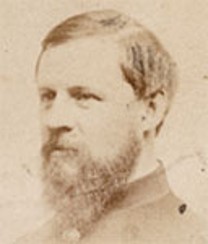
Edward H.R. Revere (FindAGrave)
Assistant Surgeon Edward H.R. Revere was the grandson of the famous Revolutionary War hero, Paul Revere. Born in Boston in 1827, Revere received his medical degree from Harvard Medical School in 1849. He set up his medical practice in Boston, and with the start of the Civil War, he was commissioned Assistant Surgeon of the 20th Massachusetts Infantry. Revere was captured at the Battle of Ball’s Bluff in October 1861, imprisoned in Richmond, and exchanged in February 1862. On September 17, 1862, at the Battle of Antietam, Revere accompanied his regiment into battle in the West Woods. He was shot and killed while caring for a wounded soldier. He was honored posthumously by brevet to Lieutenant Colonel.
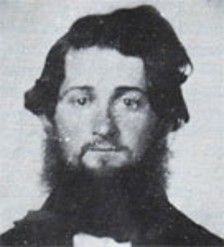
William S. Parran circa 1860 (Museum of the Confederacy, Richmond)
The case of the Confederate surgeon who was killed at Antietam is unique, as he was acting as a combatant. Assistant Surgeon William S. Parran was born in Virginia in 1834 and graduated from Baltimore Medical College in 1857. He set up his medical practice in Barbourville, Virgina and in 1859 he organized and was given command of a battery of artillery for the local militia. When the Civil War began in April 1861, Parran took the battery to Harpers Ferry to join other units organizing there. On April 17, he was mustered into service as a captain in Company F of the 13th Virginia Infantry. In December of 1861 he became ill with jaundice and had to resign his commission. By the end of the summer in 1862, Parran had regained his health and was given a position as Assistant Surgeon in Courtney’s Battalion of Artillery. On September 17, 1862, during the Battle of Antietam, Parran was detached from his battery and accompanied the Washington Artillery of New Orleans. During the battle, a large number of the battery members were killed and the officers pitched in to help with the field pieces placed in the apple orchard of the Piper Farm. Parran was killed while helping to man the guns.
The deaths of these four surgeons on the battlefield of Antietam shed a light on the incredible risks that medical personnel had to take during the Civil War in order to care for the fighting soldiers who were wounded. Despite the many innovations in medical care and evacuation procedures brought about by men such as Dr. Jonathan Letterman, some of these surgeons, like their comrades in arms, made the ultimate sacrifice for their country
Sources
Antietam on the Web: https://antietam.aotw.org/officers.php?officer_id=13824&from=results
Commonwealth of Massachusetts, Adjutant General, Massachusetts Soldiers, Sailors, and Marines in the Civil War, Vol. 2, pg. 3
FindAGrave: https://www.findagrave.com/memorial/72084633/edward-hutchinson_robbins-revere
Frassanito, William A., Antietam: The Photographic Legacy of America’s Bloodiest Day, 1978, pp. 211-214
National Park Service, Medicine and Medical Practices https://home.nps.gov/articles/medicine-and-medical-practices.htm
Woodard, Scott C.; Wunderlich, George; Austerman, Wayne. Combat Readiness Through Medicine at the Battle of Antietam, Borden Institute, U.S. Army Medical Center of Excellence, 2022.
About the Author
Tracey McIntire earned her BA in English at Rivier College in Nashua, NH. She is Lead Educator at the National Museum of Civil War Medicine and an interpretive volunteer at Antietam National Battlefield. She is also an active Civil War living historian, where she portrays a woman soldier in various guises.
Tags: Battle of Antietam, Civil War surgeons Posted in: Civil War Medical Personnel, People